IDF Tank Corps Memorial "Yad L's hyrion" in Latrun


About Yad L'Shiryon- Memorial to fallen soldiers

Located in the Ayalon Valley the former British colonial police fort has been an item of import for over 60 years. Used to dominate both the Israeli and Arab populace during the Mandate period, it's location took on additional importance during Israel's War of Independence. During the war the road to Jerusalem which passed near latrun was often blocked by local arab forces. For the Israeli populace having only recently declared independence in the Jewish areas of the partition, the loss of Jerusalem would be unthinkable. Abdallah of Jordan saw the situation as a means of gaining territory and possibly Mediterranean access. He sent The Arab Legion to take up positions in both the Byzantine old city of Jerusalem as well as Latrun. This effectively blockaded Israeli West Jerusalem.

The new Israeli government knew the situation and attacked the police fort and surrounding areas on three occasions, once getting forces into the fort. Each time however the new Israeli army was pushed back with often grievous losses. The solution was to build a bypass road which is called the 'Burma Road' . This was really nothing more than an improvised, hastily constructed road that enabled supplies to reach western Jerusalem thus breaking the siege and securing Jerusalem as Israel's new capital. Although the fort itself was abandoned by the Legion after the siege had been broken it would remain in Jordanian hands until 1967 when it was liberated by forces of Uzi Narkess's central command.

In 1982 the cornerstone for what would be the memorial and museum was laid. With the help of both sitting and retired officers the museum at Latrun has grown into one of the predominant armour museums in the world. It houses not only examples of IDF vehicles and those captured in it's many wars but examples bought or traded for from around the world. Today the Latrun museum houses over 100 vehicles from pre-WW2 Hotchkiss to prototypes of the Merkava 1,2 and 3. There are an array of soft vehicles as well as examples of bridging and mine clearing apparatus. The museum houses not just the inanimate metal tanks but the histories of its units and individual soldiers. This is a place to stop not just for the armour vehicle enthusiast but for anyone interested in the history of the IDF ground forces. Not unlike Yad V'shem in Jerusalem the museum and monument shows the real cost of defending ones heritage and country....... It's lost future generations

 VIRTUAL TOUR

http://www.photo3d.co.il

IDF Armor and tank corps History and background -Tzhal


Armor Corps
The Israeli Armor Corps is a corps of the Israel Defense Forces, since 1998 subordinate to GOC Army Headquarters. The Armor Corps is the principal maneuvering corps, and primarily bases its strength on Main Battle Tanks. The Armor Corps is the decisive corps in GOC Army Headquarters, and bases its “crushing power” on its “fists of steel”: a combination of mobility, armor, and firepower. During wars, its role is, on the one hand, to lead the first line of the attacking forces and to clear the area of the enemy, while on the other hand, to block the armor forces of the enemy and to destroy its tanks and armor. During peacetime, it reinforces the Infantry Corps while it performs security tasks, with the tanks serving as a mobile bunker.

Divisions and brigades

The 36th Division

Also known as the Ga’ash Formation, is the largest armor division in the IDF, and also includes Engineering Corps soldiers who are attached to it. It is stationed on the Golan Heights under the Northern Command. . It includes the 7th and 188th Brigades.

The 7th Brigade

Also known as the Sa’ar (”Storm”) Formation, this is a regular armor brigade which is placed under the command of the Northern Command. It is the first armor brigade of the IDF and has participated in all of Israel’s wars. The brigade’s fighting during the Suez War resulted in a breakthrough in how the army approached the character of armor warfare.
Today, the brigade is equipped with Mark 2 Merkava tanks.

The 188 Brigade

Also known as the Barak (”Lightning”) Formation, it is a regular armor brigade which is placed under the command of the Northern Command. Starting with the Six Day War, the brigade participated in all of Israel’s wars. During the Yom Kippur War, the brigade was the first line of defense in the first day of the war at the Southern Golan, and saw almost all of its officers killed in action. It was the last armor brigade to use the Centurion tank, converted into Merkava 3 tanks in 1992.

The 162nd Division

Also known as the Utzvat Ha’Barzel Formation, this is an armor division which is placed under the Central Command.

The 14 Armored Brigade

The brigade was active during the War of Attrition when it split to provide the basis for the 401st Armoured Brigade. During the Yom Kippur War, it was initially an armoured reserve supporting the infantry brigades holding the Bar-Lev Line. It suffered terrible casualties during the war but was rebuilt afterwards.[1]

The 211th Brigade

Also known as the Yishai (acronym for “Guardians of Jerusalem Unit”), during the Lebanon War of 1982, it was famously led by Colonel Eli Geva, who during the Siege of Beirut refused to lead his soldiers into the city for moral reasons. He was dismissed from the army, and the brigade itself was dissolved in the early 1990s.

The 401 Brigade

Also known as the Ikvot Habarzel (”Tracks of Iron”) Formation, this is an armor brigade created in 1968 in order to control the Suez Canal line. During the Yom Kippur War, it faced the first line of attack in the canal and suffered heavy losses. During the 1982 Lebanon War, it fought in the Southern force and one of its battalions participated in the Sultan Yaakov battle. During 2004-2005, the brigade’s tanks were converted into Mark 4 Merkava tanks.

The 847 Brigade

This is a reserve brigade also known as Merkavot Haplada (Steel Chariots), equipped with Mark 2 Merkava tanks. Up to the year 2000 the main equipment was old Magach AFVs. Recently, the brigade took part in the 2006 Lebanon War, most notably in the Battle of Bint Jbeil and battle of Yaroon, in the war the brigade eliminated approximately 60 Hezbollah fighters.

The 460th Brigade

Also known as the Bney Or (”Sons of Light”) Formation, this is the training brigade of the Armor Corps. It maintains two bases: the Shizafon (”tanning”) base, which is the training school for the corps’ commanders, where the officers and tank commanders are instructed. The Magen Sayarim (”Scout Defense”) Camp maintains the armor training school where basic and continued training is undertaken, preparing armor combatants toward the operational brigades.

The 500 Brigade

Also known as the Kfir (”Young Lion”) Formation, this was a regular armor brigade which operated from 1972 until 2003. During the Yom Kippur War, it participated in the battle over the city of Suez. During the Lebanon War of 1982, it fought in the framework of the Eastern force and participated in the Eyn Zhalata battle. After the 2003 invasion of Iraq, and the lessening of the threat from the eastern front, the brigade was dissolved.

Barak Armored Brigade:

Introduction

The Barak Brigade is one of the regular armored brigades of the Northern Command. The Barak Brigade was formed before the establishment of the State of Israel, when it was known as the Carmeli Brigade. It was then an infantry brigade which fought in the north of Israel, from the Western Galilee to kibbutz Manara. Today, the brigade’s symbol is that of the Carmeli brigade, which has been used since the brigade was established. After the establishment of the State, all the independent Jewish fighting units were dismantled, the IDF was created and the Carmeli brigade became the “18th Brigade”. During the Sinai Campaign, the brigade was deployed on the Jordanian border, and therefore did not have an active role in the combat. One of the main conclusions after the war was that the army needed armored units, and the 18th Brigade started the changeover by becoming “the 45th Armored Brigade”.

The brigade commander, Moshe Bar-Kochba (Brill) commanded the brigade in the Six Day War. The brigade received the Eastern sector. The IDF took the initiative to attack, in order to remove the threat of the Long Tom guns on the valley settlements and on the Ramat David airfield. The brigade fought a number of bloody battles in the Dotan Valley, which ended with the blowing up of the Jordan river bridges.

At the start of the 1970s, the brigade participated in armored attacks on terrorist bases in South Lebanon and Syria.

The experiences of the brigade during the Yom Kippur War in 1973 were particularly difficult. At the time, the Barak brigade was the only regular armored force on the Golan Heights. In the light of intelligence reports, the 7th Armored Division was sent to the Golan Heights two days before the outbreak of hostilities. However, the 7th Division soldiers were not familiar with the Golan Heights. The two brigades were spread out is isolated teams along the border line. The Barak brigade was responsible for the Southern Golan Heights sector. The main Syrian efforts to break through the border was in the Southern Golan Heights area, and the ratio of defenders to attackers forces was extremely unfavorable.

During the Yom Kippur War, 112 soldiers from the Barak brigade were killed in action.
After the war the brigade rebuilt itself and later participated in the Litani Campaign and other armored operations.

In the Peace for Galilee War, the brigade led division forces into Lebanon. This war was in built-up areas, hardly the typical combat arena for armor. The brigade fought in the Beirut sector, and participated in the capture of the airport. It then continued to fight in the eastern sector in Lebanon. The brigade participated in all subsequent redeployments stabilizing the lines in the Lebanese sector, and was among the last forces to leave Lebanon.


In recent years, the brigade has changed over from the Centurion tank, which it used for an entire generation, to the ultramodern Merkava Mark 3 main battle tank. This changeover to the best combat tank in the world today has just been completed.

General Israel Tal (Talik) the father of the Merkava MBT אלוף ישראל טל (טליק) אבי טנק המרכבה


General Tal with Moshe Dayan and IDF Chief of staff  Bar Lev


General Tal with IDF chief of staff Rabin in the 60's
Photo by Beny Hadar Bamahane IDF monthly


Photo by Michel Astel Bamahane IDF monthly


General Tal during Six Days War (on the left)


Israel Tal (born 1924), also known as Talik , is an Israel Defense Forces (IDF) general known for his knowledge of tank warfare. Tal was a brigade commander during the Sinai War, an armored-division commander in Sinai Peninsula during the Six Day War, and commander of the southern front during the final stages of the Yom Kipur War.

The Israeli government decided in 1970 that it needed tank-building capacity. General Israel Tal led a development team which took into consideration Israel's battlefield characteristics and lessons learned from previous wars, and began the development and building of Israel's Merkava tank.

Israel Tal's picture appears in Patton Museum of Cavalry and Armor "Wall of Greatest Armor Commanders" along with Moshe Peled (also Israeli), Americans George S. Patton and Creighton Abrams and German field-marshal Erwin Rommel.

Tal received the Israel Prize in 1997 for "[A] special contribution to the society and state". In 2002 he was chosen "Knight of Quality Government" by the Movement for Quality Government in Israel in the "Military and security" category.

Armour Doctrine

Gen. Tal is the creator of the Israeli armour doctrine which led to the Israeli successes in the Sinai in the Six Day War. After the Suez Crisis, Tal organized the armour into the leading element of the Israeli Defense Forces, characterized by high mobility and relentless assault. General Tal took over Israeli armor corps in 1964 and re-trained all Israeli gunners to hit targets beyond 1.5km. [1] In open terrain, this long distance gunnery proved vital to survival of Israeli armor corps for subsequent wars. Mobility is comparable to the German Blitzkrieg and many hold it to be an evolution of that tactic. Tal's transformation and success in 1967 led the IDF to expand the role of armour. This led to reduced attention to other less glamorous aspects of the army such as the Infantry. In the 1973 Yom Kippur War, excessive focus on fast striking armour left the IDF without adequate defensive ability. Only in latter stages of the war did the armour break out and show its potential when General Ariel Sharon's armour was able to penetrate the Egyptian lines, cross the Suez Canal and envelope the Egyptian 3rd Army near Suez.

While the IDF has become a more balanced force since 1973, Tal's influence on armour doctrine was very important to the IDF's development and has influenced armoured doctrines the world over.

TALIK: Steel Division-Six
Patton Museum Ceremony Honors Major General Israel Tal (Ret.)
Mounted Leader of the Israeli Defence Forces
for more visit the link:
center\ocoa\armormag\backissues\1990s\1997\jf97\1talik97.pdf (application/pdf Object)


On 25.4.2010
A square in Israel Tal home town Rehovot  named "MERKAVA"  a tribute to
his long service for the IDF and the state of Israel


Israel Tal, a teenager at the time, fought as a sergeant in the Jewish Brigade with British forces in Italy in World War II. He would leave that war just in time to participate in the Israeli War of Independence, and again in the 1956 War, and again as a division commander in the Six-Day War (1967). Then as the Israelis struggled to separate themselves from dependence on foreign equipment, General Tal set about to design and produce a tank, a tank for the unique combat circumstances faced by the Israeli Defense Force. The Merkava was the result and is by all odds the best of the world’s tanks in terms of most nearly meeting the requirements set forth for it by the user – the Armoured Corps of the Israel Defense Force. In every detail it is Tal’s tank. Its capabilities include, among other things, the ability to provide crew and vehicle survivability at levels never dreamed of before its design. Syria’s attempt to divert water away from the Jordan River from the snow melt run-off on the slopes of Mount Hermon on the Golan Heights prompted the Merkava’s capability for long range gunnery. That run-off was a critical source of water into the Jordan. Having failed at political persuasion with the Syrians, Israel called on its Armoured Corps to solve the problem. Tal and his tanks opened fire across the border onto the Syrian bulldozers digging trenches to divert the water. The Syrians backed up the mountain; the tanks opened fire at greater range. After several such episodes, the digging stopped, not to be resumed. The Armoured Corps became world class long-range tank gunners and the water continued to flow into the Jordan.


Share

IDF Armor in the War of Independence 1948

IDF Golani Brigade 1948


צילום:ארכיון משרד הבטחון


צילום:ארכיון צה"ל -משרד הבטחון

VISIT MY 1948 IDF BLOG

http://idf-israel1948.blogspot.com/

Marmon Harrington mk4 armored car during a  parade 1949


The Arab-Israeli War of 1948 broke out when five Arab nations invaded territory in the former Palestinian mandate immediately following the announcement of the independence of the state of Israel on May 14, 1948. In 1947, and again on May 14, 1948, the United States had offered de facto recognition of the Israeli Provisional Government, but during the war, the United States maintained an arms embargo against all belligerents.

On November 29, 1947, the United Nations General Assembly adopted Resolution 181 (also known as the Partition Resolution) that would divide Great Britain's former Palestinian mandate into Jewish and Arab states in May 1948. Under the resolution, the area of religious significance surrounding Jerusalem would remain under international control administered by the United Nations. The Palestinian Arabs refused to recognize this arrangement, which they regarded as favorable to the Jews and unfair to the Arab population that would remain in Jewish territory under the partition. The United States sought a middle way by supporting the United Nations resolution, but also encouraging negotiations between Arabs and Jews in the Middle East.

The United Nations resolution sparked conflict between Jewish and Arab groups within Palestine. Fighting began with attacks by irregular bands of Palestinian Arabs attached to local units of the Arab Liberation Army composed of volunteers from Palestine and neighboring Arab countries. These groups launched their attacks against Jewish cities, settlements, and armed forces. The Jewish forces were composed of the Haganah, the underground militia of the Jewish community in Palestine, and two small irregular groups, the Irgun, and LEHI. The goal of the Arabs was initially to block the Partition Resolution and to prevent the establishment of the Jewish state. The Jews, on the other hand, hoped to gain control over the territory allotted to them under the Partition Plan.

After Israel declared its independence on May 14, 1948, the fighting intensified with other Arab forces joining the Palestinian Arabs in attacking territory in the former Palestinian mandate. On the eve of May 14, the Arabs launched an air attack on Tel Aviv, which the Israelis resisted. This action was followed by the invasion of the former Palestinian mandate by Arab armies from Lebanon, Syria, Iraq, and Egypt. Saudi Arabia sent a formation that fought under the Egyptian command. British trained forces from Transjordan eventually intervened in the conflict, but only in areas that had been designated as part of the Arab state under the United Nations Partition Plan and the corpus separatum of Jerusalem. After tense early fighting, Israeli forces, now under joint command, were able to gain the offensive.

Though the United Nations brokered two cease-fires during the conflict, fighting continued into 1949. Israel and the Arab states did not reach any formal armistice agreements until February. Under separate agreements between Israel and the neighboring states of Egypt, Lebanon, Transjordan, and Syria, these bordering nations agreed to formal armistice lines. Israel gained some territory formerly granted to Palestinian Arabs under the United Nations resolution in 1947. Egypt and Jordan retained control over the Gaza Strip and the West Bank respectively. These armistice lines held until 1967.


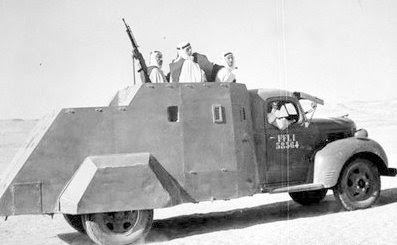
Armored trucks on the road to Jerusalem used during the blockade

IDF Armor history -Dagania battle first tank kill 1948

 הקרב על  דגניה עימות מול טנקי אוייב 1948 מלחמת השחרור


Syrian armored truck hit by the IDF near Degania .The Sea of Gallile is in the back along the Golan


Golani brigade visit the site when the war was over


The Battles of the Kinarot Valley , is a collective name for a series of military engagements between the Haganah and the Syrian army during the 1948 Arab-Israeli War, fought between May 15–22, 1948 in the Kinarot Valley. It includes two main sites: the Battle of Degania-Tzemah, and battles near Masada-Sha'ar HaGolan. The engagements were part of the battles of the Jordan Valley, which also saw fighting against Transjordan in the area of Gesher.

The battles began shortly after the Israeli declaration of independence, when Syria shelled Ein Gev on the night of May 15–16. They were the first military engagement between Israel and Syria. On May 18, Syria attacked the Israeli forward position in Tzemah (Samakh), and on May 20 attacked Degania Alef and occupied Masada and Sha'ar HaGolan. The attack on Degania Alef was a failure, after which the Syrian forces attempted to capture Degania Bet. After reaching a stalemate, they retreated to their initial position in Tel al-Qasr, where they remained until the end of the war.

The campaign was perceived as a decisive Israeli victory, causing reorganizations in the Syrian high command and tales of the heroics in Degania becoming popularized in Israel. However, Syria made a small territorial gain and certain actions were criticized within Israel, such as the retreat from Masada and Sha'ar HaGolan.

The first stage of the 1948 Arab-Israeli War, referred to as the 1947–1948 Civil War in Mandatory Palestine, started following the ratification of UN Resolution 181 on November 29, 1947, which granted Israel the mandate to declare independence. Despite the Arab states' threats on the Jewish population of the British Mandate of Palestine should they declare independence, as well as the American truce offer, the head of the Provisional State Council, David Ben Gurion, declared independence on May 14, 1948. On the night between May 14 and 15, the states of Egypt, Iraq, Transjordan, Lebanon, Saudi Arabia, Syria and Yemen invaded the newly-created state.

During the days prior to the declaration of independence, the Arab states surrounding the Mandate of Palestine massed their forces at the borders in preparation for the scenario. According to the Arab plan, the Syrian army was to attack the new state from southern Lebanon and capture Safed. As such, the Syrians massed their forces in that area; however, after they found out that Lebanon did not wish to actively participate in combat, their plans changed to an attack from the southern Golan Heights on Samakh (Tzemah) and later Tiberias. The Syrian force assembled in Qatana on May 1. It moved on May 12 to Beirut and to Sidon on May 13, after which it headed to Bint Jbeil. After the sudden plan change, the force moved to Nabatieh, and proceeded around the Finger of the Galilee to Banias and Quneitra, from which the eventual attack was staged.

According to plan, the Syrians attacked from the southern Golan Heights, just south of the Sea of Galilee through al-Hama and the Yarmouk River, hitting a densely-populated Jewish area of settlement. This came as a surprise to the Haganah,which expected an attack from south Lebanon and Mishmar HaYarden. The Jewish villages on the original confrontation line were Ein Gev, Masada, Sha'ar HaGolan and both Deganias.

On Friday, May 14, the Syrian 1st Infantry Brigade, commanded by Colonel Abdullah Wahab el-Hakim, was in Southern Lebanon, positioned to attack Malkia. That day Hakim was ordered to return to Syria, move south across the Golan and enter Palestine south of the Sea of Galilee through Tzemah. He began to advance at 9:00 AM on Saturday. He had only two of his battalions, and they were exhausted.

At the onset of the invasion, the Syrian force consisted of a reinforced infantry brigade, supplemented by at least one armored battalion (including Renault R35 tanks) and a field artillery battalion. The troops moved to Kafr Harib and were spotted by Haganah reconnaissance, but because the attack was not expected, the Israeli troops did not attack the invaders.[10] At night between 15 and 16 May, the bulk of the Syrian forces set up camp in Tel al-Qasr in the southwestern Golan. One company with armored reinforcements split up to the south to proceed to the Jewish Water Institute on the Yarmouk riverbank.

The Haganah forces in the area consisted of several units from the Barak (2nd) Battalion of the Golani Brigade, as well as the indigenous villagers, including a reduced Guard Corps (HIM) company at the Tzemah police station. The commander of this force was the deputy of Avraham Yoffe, the battalion commander.On May 13, the battalion commander declared a state of emergency in the area from May 15 until further notice. He authorized his men to seize all necessary arms from the settlements and urged them to dig in and build fortifications as fast as possible, and to mobilize all the necessary work force to do so.

Battles
Breakdown of the battles on May 16

On Saturday night, May 15, the observation posts reported many vehicles with full lights moving along the Golan ridge east of the Sea of Galilee.[15] The opening shots were fired by Syrian artillery on kibbutz Ein Gev at approximately 01:00 on May 16. The following day, the Syrian company which split from the main force attacked the Water Institute, where every worker was killed except one. The company then proceeded towards Sha'ar HaGolan and Masada. Its advance was halted by the village residents as well as a platoon of reinforcements armed with 20 mm cannons. The company retreated to its position and commenced artillery fire on the two kibbutzim. An Israeli reserve unit was called in from Tiberias. It arrived after twenty minutes and took positions around the town. At that point, Tzemach was defended by three platoons from the Barak battalion and reinforcements from neighboring villages.

This development gave the Israeli forces time to organize their defenses at Samakh (Tzemah). During the course of May 16, Israeli gunboats harassed the Syrian positions on the southeastern Sea of Galilee shore. Meanwhile, Syrian aircraft made bombing runs on Masada, Sha'ar HaGolan, Degania Bet and Afikim. The attack on Tzemah resumed on May 17—the Syrians set up their positions in an abandoned British military base just east of the village and in "The Quarantine" (an installation that checked for contaminated cattle), while the Israeli forces entrenched in the actual village and its police station, which had been abandoned by the residents in April 1948, with British escort. A Syrian force attempted to surround the Israelis by crossing the Jordan River to the north of the Sea of Galilee, but encountered a minefield in which a senior Syrian officer was wounded.
This additional reprieve allowed the Israelis to evacuate the children, elderly and sick from the Kinarot Valley, as well as conduct maneuvers which feigned massive reinforcements in the Poria-Alumot region.In the panic of surprise, many men also tried to flee the frontal villages, but blockposts were set up near Afula and Yavne'el by the Military Police Service's northern command, under Yosef Pressman, who personally stopped buses and allowed only the women and children to proceed to safety.

Tzemah
Breakdown of the battles on May 18–19 (Battle of Tzemah)

On the morning of May 18, the Syrian 1st Brigade, now commanded by Brigadier-General Husni al-Za'im and consisting of about 30 vehicles, including tanks, advanced west towards Tzemah (Samakh) in two columns—one across the coast, and another flanking from the south. A contingent was allocated further south, in order to secure the safety of the main force by flanking Sha'ar HaGolan and Masada from the west. It entered a stalemate with a new Israeli position northwest of the two villages. The coastal column shelled the Israeli positions and inflicted enormous damage, due to the Israelis' lack of time to properly dig in. Reinforcements from the Deganias arrived but were immediately hit by the Syrians and did not significantly affect the battle. After the second column reached Tzemah, the Haganah retreated, fearing a cut-off of its retreat route to the Deganias by the latter column. The retreat was disorganized and heavy Israeli casualties were recorded as Tzemah's police station fell.

On the same day, Syrian aircraft bombed the Israeli village Kinneret and the regional school Beit Yerah, on the southwestern shore of the Sea of Galilee. By evening, Tzemah had fallen and a new Israeli defensive line was set up in the Deganias, facing the Syrian counterparts. At night, a Palmach company attempted to recapture Tzemah and assaulted the police station, but were warded off. On the morning of May 19, a message was sent to Masada and Sha'ar HaGolan to prepare for an evacuation, although when the final order was given to stay put, the villages had already been abandoned, mostly to Afikim. At 8:00 AM the Syrian troops captured the villages without a fight. The villages were subsequently looted and destroyed by the Syrians.

The counterattack on the police station failed but delayed the Syrian attack on the Deganias by twenty-four hours. In the evening of May 19, a delegation from the Deganias arrived in Tel Aviv to ask for reinforcements and heavy weapons. One of its members later wrote that David Ben-Gurion told them he could not spare them anything, as "The whole country is a front line". He also wrote that Yigael Yadin, the Chief Operations Officer of the Haganah, told him that there was no alternative to letting the Arabs approach to within twenty to thirty meters of th gates of Degania and fight their tanks in close combat.

Degania Alef
Breakdown of the battles on May 20–22 (Battle of Degania)

After the fall of Tzemah, the Haganah command realized the importance of the campaign in the region, and made a clear separation between the Kinarot Valley and the Battle of Gesher to the south against Transjordan. Moshe Dayan was given command of the Kinarot campaign, and a company of reinforcements from the Gadna program was allocated, along with 3 PIATs. Other reinforcements came in the form of a company from the Yiftach Brigade and another company of paramilitaries from villages in the Lower Galilee and the Jezreel Valley. The Palmach counterattack on the police station on the night of May 18 gave the Israeli forces an additional day to prepare defense and attack plans.

The Israelis called the reinforcements assuming this was the main Syrian thrust. The Syrians were not intending to carry out any further operation south of the Sea of Galilee and planned to make their main effort further north, near the Bnot Ya'akov bridge. On May 19, the Iraqis were about to drive west through Nablus toward Tulkarm, and asked the Syrians to make a diversion in the Degania area to protect their right flank. The Syrians complied, their main objective being to seize the bridge across the river north of Degania Alef, thus blocking any Israeli attack from Tiberias against the Iraqi line of communications.

Heavy Syrian shelling of Degania Alef started at about 04:00 on May 20 from the Tzemah police station, by means of 75 mm cannons, and 60 and 81 mm mortars.[13] At 04:30 on May 20, the Syrian army began its advance on the Deganias and the bridge over the Jordan River north of Degania Alef.[4] Unlike the attack on Tzemah, this action saw the participation of nearly all of the Syrian forces stationed at Tel al-Qasr, including infantry, armor and artillery. The Israeli defenders numbered about 70 persons. At night, a Syrian expeditionary force attempted to infiltrate Degania Bet, but was caught and warded off, which caused the main Syrian force to attack Degania Alef first.[1] At 06:00, the Syrians started a frontal armored attack, consisting of 5 tanks, a number of armored vehicles and an infantry company.[4] The Syrians pierced the Israeli defense, but their infantry was at some distance behind the tanks. The Israelis knocked out four Syrian tanks and four armored cars with 20 mm cannons, PIATs and Molotov cocktails.[21] Meanwhile, other defenders kept small arms fire on the Syrian infantry, who stopped in citrus groves a few hundred meters from the settlements. The surviving Syrian tanks withdrew back to the Golan.[18] They left behind a number of lightly damaged or otherwise inoperable tanks that the Israelis managed to repair.

Degania Bet

Despite the Syrian superiority in numbers and equipment, the destruction of a multitude of armored vehicles and the infantry's failure to infiltrate Degania Alef was the likely cause for the retreat of the main Syrian force to Tzemah. A less-organized and sparsely-numbered armored and infantry force forked off to attack Degania Bet.[1] Eight tanks, supported by mortar fire, moved within 400 yards of the settlement defense, where they stopped to provide fire support for an infantry attack. The Syrians made to failed attempts to breach the Israeli small arms fire defense and gave up the attempt.

While the battle was taking place, a delegation from the Deganias travelled to the government headquarters in Tel Aviv to request weapons and reinforcements. The General Staff Chief of Operations Yigael Yadin denied the request, but was compelled to provide (for just 24 hours) four newly-received Napoleonchik field cannons, by Prime Minister David Ben Gurion. The artillery reached the front in the middle of the day and was placed on the Poria-Alumot range.[1] It was the first Israeli artillery to be used in the war.[23] While the soldiers who operated the cannons (still lacking sights) were not proficient in handling them, an acceptable level of accuracy was achieved after practice shots into the Sea of Galilee. The artillery fire took the Syrian army by complete surprise, and the latter decided to regroup and retreat to Tel al-Qasr, also recalling the company at Sha'ar HaGolan and Masada.

There were two reasons for the Syrian withdrawal. A Palmach battalion from the Yiftach Brigade had been sent by boat during the previous night across the sea to Ein Gev. It climbed up the Golan and carried out a counter raid at dawn on Kafr Harib, threatening the line of communications of the 1st Brigade. The second reason was that they were running out of ammunition: Husni al-Za'im had been promised replenishment, and attacked Degania short of ammunition. Za'im ordered a withdrawal when his troops ran out of ammunition. The replenishment was instead sent to the 2nd Brigade further north. The Israelis were not aware of this, and attributed the Syrian withdrawal to surprise at the Israeli artillery fire.

Aftermath and effects

On May 21, Haganah troops returned to Tzemah and set up fortifications,[1] The damaged tanks and armored cars were gathered and taken to the rear. The settlers returned that night to identify the bodies of their comrades in the fields and buried them in a common grave in Degania.[24] At dawn on May 21, the Golani staff reported that the enemy was repelled but that they were expecting another attack. The full report read:
“ Our forces repelled yesterday a heavy attack of tanks, armored vehicles and infantry that lasted about 8 hours. The attack was repelled by the brave stand of our men, who used Molotov cocktails and their hands against the tanks. 3" mortars and heavy machinery took their toll on the enemy. Field cannons caused a panicked retreat of the enemy, who yesterday left Tzemah. This morning our forces entered Tzemah and took a large amount of booty of French ammunition and light artillery ammunition. We have captured 2 tanks and an armored vehicle of the enemy. The enemy is amassing large reinforcements. We are expecting a renewal of the attack.

On May 22, villagers returned to Masada and Sha'ar HaGolan, which had been largely destroyed. Expecting another attack, reinforcements from the Carmeli Brigade took up positions in the two villages.
Preserved Renault R35 tank captured by Israel in Degania. The PIAT's hit can be seen at the top of the turret.

In the wake of the fall of Gush Etzion, news of Degania's successful stand (as well as that of Kfar Darom) provided a morale boost for other Israeli villages. The success of the Napoleonchik field cannons prompted the Israeli high command to re-use two of them in attempts to capture Latrun. The flight from Masada and Sha'ar HaGolan, on the other hand, stirred controversy in the young state, fueled by news of the Kfar Etzion massacre just days before, and the Palmach issued a newsletter accusing them of abandoning national assets, among other things. These accusations were subsequently repeated in media and in a play by Yigal Mossensohn, and a campaign was started by the villagers to clear their name.

The battles of the Kinarot Valley were the first and last of the major ground engagements between Israel and Syria to the south of the Sea of Galilee, although minor patrol skirmishes continued until the first ceasefire. Despite the Syrians holding Tel al-Qasr, which was part of the British Mandate of Palestine and the Jewish state according to the UN partition of 1947, the offensive was considered a decisive Syrian defeat by both sides. The Syrian defense minister Ahmad Sharabati and Chief of Staff Atafa blamed each other, the latter resigning and the former being dismissed by the prime minister as a result of the battle.

First tank kill controversy

The first Syrian tank damaged near Degania Alef's gates, which has been preserved on the location, was the subject of a historiographic dispute when Baruch "Burke" Bar-Lev, a retired IDF colonel and one of Degania's native defenders at the time, claimed that he was the one who stopped the tank with a Molotov cocktail However, his account was rebutted by an IDF Ordnance Corps probe, which in 1991 determined that a PIAT shot had killed the tank's crew. Shlomo Anschel, a Haifa resident who also participated in the battle, told Haaretz in 2007 that the tank was hit by PIAT fire from a Golani soldier, and that the Molotov cocktail could not possibly have hit the crew


Renault R35
Type Light tank
Place of origin France
Service history
Used by Syria during 1948 war
Production history
Designed 1934
Manufacturer Renault
Produced 1936-1944

The Renault R35, an abbreviation of Char léger Modèle 1935 R or R 35, was a French light infantry tank of the Second World War. Designed in the mid-1930s, it was the most numerous French tank in the early stages of the conflict. It was also used by other armies and sold to Syria in large numbers

IDF Sherman platoon pre 1967

IDF Sherman platoon pre 1967

1967 arab propaganda

1967 arab propaganda
Israel must be strong